

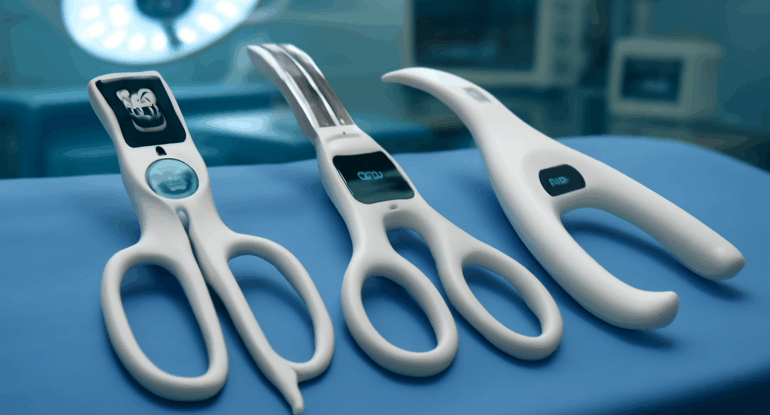
( Examples of surgical instruments designed at PSH Design )
Introduction :
The convergence of advanced engineering and medical science has driven a transformative shift in the design and production of surgical instruments and cranial implants. Additive manufacturing—commonly known as 3D printing—stands at the forefront of this revolution, enabling unprecedented levels of customization, precision, and efficiency in surgical solutions. This article explores the latest trends, applications, and future prospects of additive manufacturing in cranial and surgical device innovation.
The Evolution of Surgical Instrument and Cranial Implant Design
From Traditional Methods to Additive Manufacturing
Conventional manufacturing methods, like machining or casting, have long been the backbone of surgical tool production. While reliable, they limit the complexity and personalization possible in implant and instrument design.
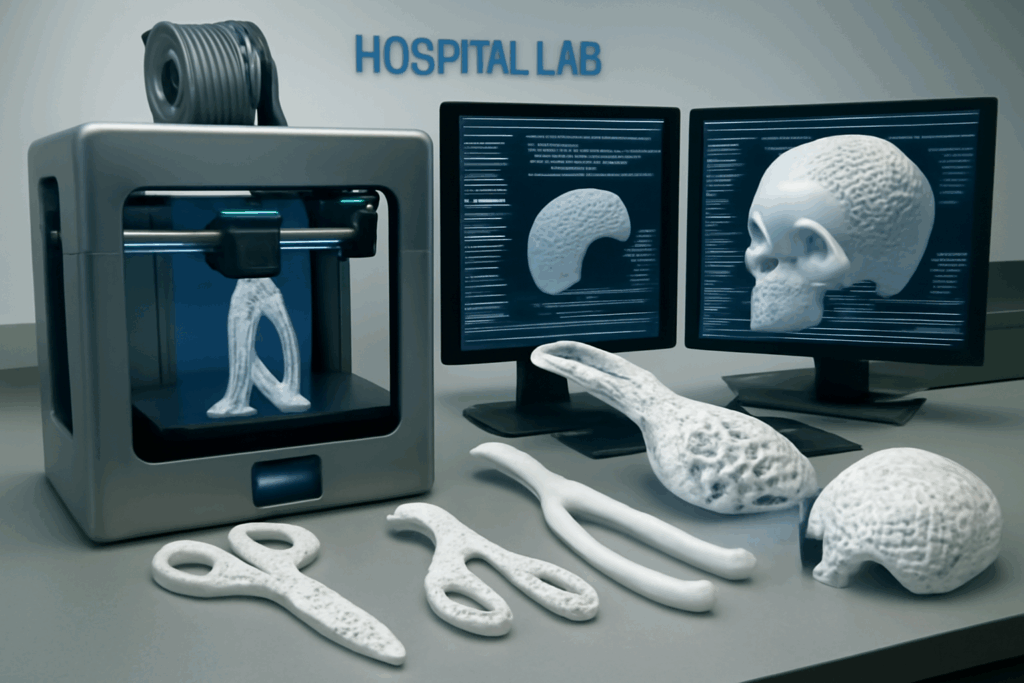
Additive manufacturing employs layer-by-layer construction from digital models, allowing intricate geometries, internal architectures, and bespoke patient-matched solutions that were previously unattainable.
Key Advantages of Additive Manufacturing in the Surgical Field
1. Customization and Patient-Specific Solutions
Cranial implants: Using patient imaging data (CT/MRI), surgeons can create perfectly conforming cranial plates tailored for each patient’s anatomy.
Surgical instruments: 3D-printed tools can be custom-shaped, ergonomically designed for particular surgeons or specific procedures, and even adapted for unique intraoperative challenges.
2. Material Innovation and Biocompatibility
Biocompatible polymers (PEEK, PMMA) and metals (titanium alloys, cobalt-chromium) are now printable, supporting durable, lightweight, and safe implants.
Porous lattice designs foster osseointegration—promoting better bonding between implants and bone.
3. Rapid Prototyping and Accelerated Development
Design iterations can be tested and revised within days instead of months, fostering innovation and clinical translation at unprecedented speed.
Hospitals and device companies can produce prototypes in-house, reducing development costs and enhancing collaboration between engineers and clinicians.
Clinical Applications:
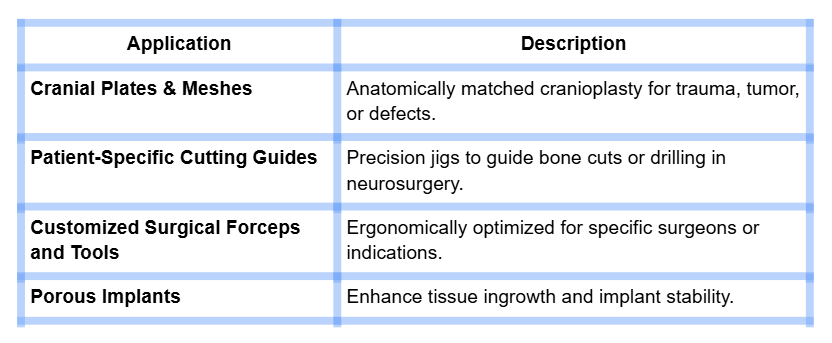
Case Studies & Real-World Impact
Facial and Cranial Reconstruction: Reports highlight reductions in surgical time, improved cosmetic outcomes, and fewer postoperative complications when using 3D-printed implants.
Orthopedic and Spinal Surgery: Patient-matched guides and implants improve alignment accuracy and long-term implant performance.
Rapid Response in Emergencies: Hospitals have deployed 3D printers for urgent production of custom implants and surgical tools during trauma or mass casualty events.
Challenges and Considerations Regulatory Compliance: All additively manufactured devices must comply with strict FDA/EMA standards for quality and safety.
Material costs and validation : Ongoing efforts are focused on lowering material prices and ensuring that new printable materials meet stringent biocompatibility and strength requirements.
Training: Surgeons and staff require new competencies in digital design principles and 3D model interpretation.
Future Outlook :
The integration of AI-driven design, more advanced biomaterials, and even on-site hospital manufacturing labs points toward a future where surgical interventions are more personalized, less invasive, and more effective. As regulatory frameworks evolve and technology matures, additive manufacturing is poised to become the standard in surgical device and implant production, fundamentally enhancing patient care worldwide.
Importance of Choosing the Right CAD Software in the Design of Surgical Instruments and Cranial Implants Using 3D Printing Technology
1. The Key to Precision and Safety in Healthcare
Accurate Design: CAD (Computer-Aided Design) enables the creation of highly detailed 3D models tailored to the specific anatomical structure of each patient – which is especially critical for cranial implants and surgical instruments requiring a perfect fit.
Compliance with Medical Standards: Specialized medical CAD software integrates standards (such as ISO, FDA) and validation tools to ensure the designs meet requirements for safety, biocompatibility, and clinical testing.
2. Optimizing the Process From Concept to 3D Production
Specialized 3D Print File Export: Appropriate CAD software allows exports in formats (STL, OBJ, AMF, STEP, etc.) optimized for medical 3D printing, minimizing data conversion errors that may cause deformation or inaccuracy.
Integrated Mesh Techniques and Simulation Testing: Modern CAD software supports stress simulation, force penetration, and soft tissue interaction—helping predict performance and safety before production.
3. Supporting Customization and Personalization
Design From Personalized Medical Data: CAD design can directly derive models from CT/MRI imaging (with software such as Materialise Mimics, 3DSlicer, or specialized modules in SolidWorks and Autodesk Fusion 360) to create implants and instruments perfectly customized for each case.
Enhanced Support for Surgical Teams: High-quality CAD software allows efficient collaboration among engineers, surgeons, and manufacturers—facilitating edits, approvals, and reducing miscommunication.
4. Driving Innovation
Rapid Prototype Development: Powerful CAD software helps R&D teams create, test, and refine multiple design concepts for instruments and implants in days rather than weeks, boosting innovation.
Integration of AI and Advanced Simulation: Some advanced CAD platforms include AI, automated geometry optimization, ventilation hole layouts, and support for histological or flow simulation for advanced product development.
5. Increasing Efficiency and International Collaboration
Cost and Time Savings: Choosing the right CAD tool significantly reduces rework and correction costs, and shortens the time from design to production.
Easy Global Project Transfer: Standardized CAD data are easy to share, edit, and manage across international supply chains.
Conclusion
Choosing the right CAD design software not only raises the quality and safety of 3D-printed surgical instruments and cranial implants, but also underpins innovation, compliance with international standards, and optimization of the entire design-to-production workflow in biomedical engineering.
Examples of Suitable CAD Software for Surgical Design and 3D Printing
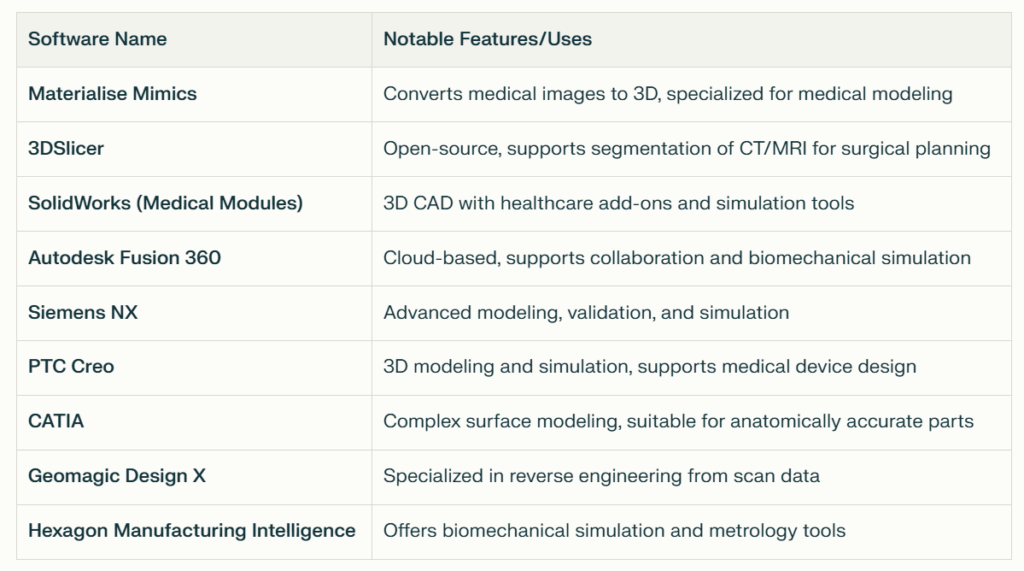
These platforms are widely used in both research and commercial production of patient-specific implants and surgical devices due to their precision, simulation capabilities, and integration with medical imaging and 3D printing workflows.
Conclusion :
Additive manufacturing is reshaping the landscape of cranial implants and surgical instruments, delivering a new era of precision medicine and customized care. As technology continues to advance, next-generation surgical designs will not only improve patient outcomes but also redefine the possibilities of medical engineering.
References:
“3D-Printed Cranial Implants: A Review,” Frontiers in Surgery.
“The Impact of Additive Manufacturing on Surgical Instrumentation,” Applied Sciences.
“Regulatory and Material Advances in 3D Printing for Surgery,” Journal of Medical Devices.
( PSH Design Team )
Contact for free test project : https://pshdesign.com/rfq-free-test-project/
